

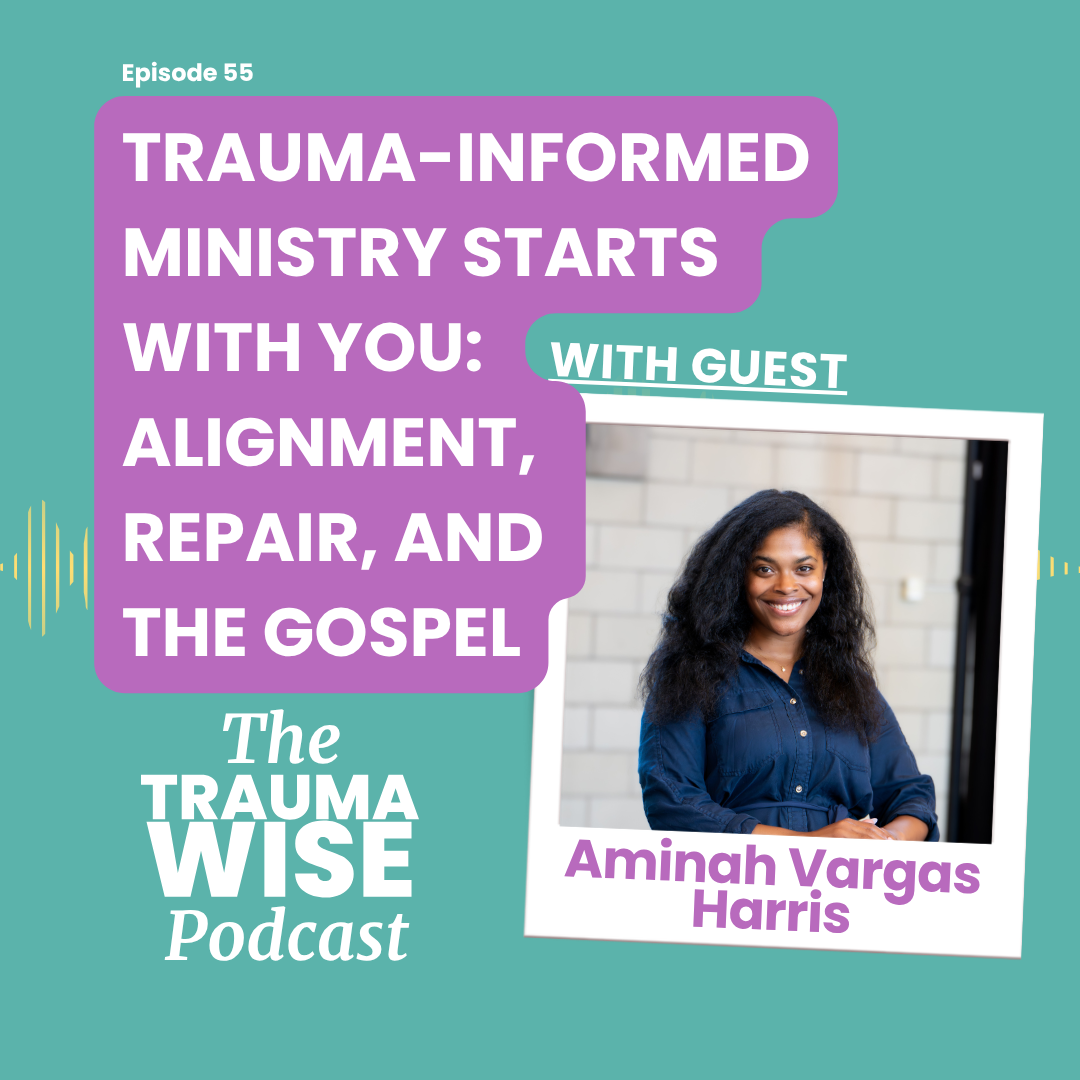
Trauma-Informed Ministry Starts With You: Alignment, Repair, and the Gospel (with Aminah Vargas-Harris)
Many churches want to become trauma-informed.
They want to be safe.
They want to be healing.
They want people to feel welcomed, cared for, and seen.
But trauma-informed ministry does not begin with a new program.
It begins with the people leading, serving, teaching, greeting, praying, listening, and holding space.
In this TraumaWise Podcast episode, Renae M. Dupuis speaks with Aminah Vargas-Harris, a trauma-informed ministry and organizational consultant, about what it means to integrate trauma-informed practice into faith communities in a way that is embodied, relational, and aligned with the gospel.
Aminah’s core reminder is simple and profound:
Trauma-informed ministry starts with you.
When Theology and Practice Don’t Align
One of the most powerful stories Aminah shares comes from her teenage years.
A young girl in her church became pregnant and was removed from visible ministry roles once she began showing. She was no longer allowed to serve communion or sing with the youth group. The message was clear: hide the evidence of your humanity.
For Aminah, even as a young person, something felt deeply wrong.
A church that spoke of love, grace, acceptance, and restoration was practicing exclusion, shame, and invisibility.
That moment became part of her lifelong call to help faith communities close the gap between what they say they believe and how they actually treat people.
The Gap Between Words and Embodiment
Many faith communities have beautiful words:
grace, love, mercy, belonging, restoration, discipleship.
But words without embodied practice can create deep cognitive dissonance.
People notice when a community says “you are welcome here” but only if they look, act, believe, confess, perform, or heal in expected ways.
Trauma-informed ministry asks deeper questions:
- Are our practices aligned with our theology?
- Do our systems protect dignity?
- Does our language preserve agency?
- Are we prioritizing transformation or appearances?
- Do people feel safe enough to tell the truth?
This is not about abandoning faith.
It is about embodying it with integrity.
The SALT Framework
Aminah introduces her SALT Framework as a way for churches and faith-based organizations to move from trauma-informed awareness into trauma-informed practice.
Stabilize
Start with leadership regulation, relational consistency, transparency, and predictable ministry environments.
Align
Restore integrity between theology, leadership practice, lived experience, mission, values, and language.
Liberate
Shift from rescuing or saving people into creating environments where people have choice, agency, voice, and pathways toward their own healing.
Transform
Move from internal alignment outward into community care, justice, partnership, and systemic healing.
This framework helps ministries slow down and ask not only, “What do we want to do?” but, “Who are we becoming as we do it?”
Implementation Without Imposition
One of the strongest themes of this conversation is the difference between implementation and imposition.
Trauma-informed ministry is not about forcing healing, demanding vulnerability, or pushing people toward predetermined outcomes.
It is not about saying:
- We know what you need.
- We are here to fix you.
- Come to the altar now.
- Tell your story here.
- Be transformed on our timeline.
Instead, it asks:
- What would support look like for you?
- What helps you feel safe enough to engage?
- Where do you have choice?
- How can we walk alongside without taking over?
As Renae names in the conversation:
Consent matters in ministry.
Repair Starts From the Inside Out
Aminah shares a story of working with a group of men leading Bible study in a sober living context. Their original goal was to bring food, read Scripture, and get people to come to church.
But the people they were trying to reach were not engaging.
The repair work began when the leaders were willing to look inward.
Not “What is wrong with them?”
But “How are we showing up?”
“What assumptions are we bringing?”
“What might feel unsafe about our approach?”
“What do we need to repair in ourselves before we can connect with others?”
Over time, their goal shifted from winning people over to embodying the work with humility and presence.
That is trauma-informed ministry.
Ministry Is Not Measured Only in Numbers
Churches often track attendance, giving, baptisms, altar calls, sign-ups, and visible engagement.
Those measures may have value, but they do not tell the whole story.
Aminah invites ministries to consider different questions:
- How many genuine conversations happened?
- How many relationships deepened?
- How many people felt safe enough to tell the truth?
- How many leaders practiced repair?
- How many people experienced being accompanied instead of managed?
Trauma-informed ministry may be harder to quantify.
But it can often be felt.
A TraumaWise Invitation
Before we ask how to make our churches trauma-informed, we might begin with a more personal question:
Where am I engaging from?
Am I leading from pain?
Fear?
Scarcity?
Performance?
Control?
Hope?
Love?
The work starts there.
Because trauma-informed ministry is not a label.
It is a posture.
A practice.
A way of living the gospel with integrity.
And it starts with us.
0 comments