

“You’re Not Broken — Your Brain Is Brilliant”: Neurodivergence, Belonging, and Felt Safety (with Adair Finucane)
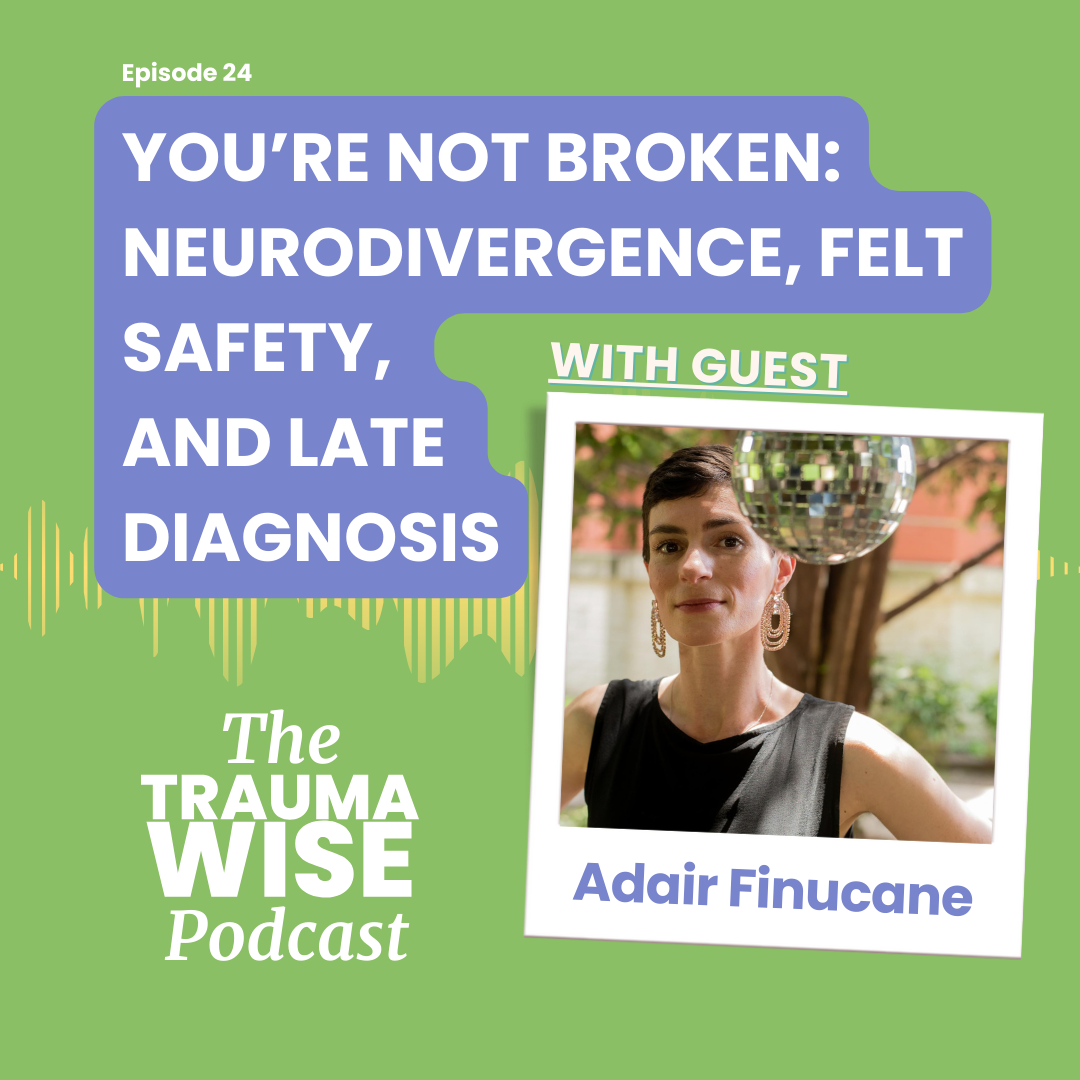
Some conversations don’t just inform — they reorient.
This episode of the TraumaWise Podcast is one of those conversations.
Renae M. Dupuis is joined by Adair Finucane, trauma-informed somatic facilitator, social worker, artist, and self-described “lizard in a suit,” for a deeply human exploration of neurodivergence, late diagnosis, nervous system needs, and what it actually means to belong.
Together, they name something many people have felt but rarely had language for:
The problem was never your brain.
The problem was the system around it.
Meet Our Guest: Adair Finucane
Adair Finucane wears many hats — parent, social worker, trauma researcher, somatic practitioner, and multidisciplinary artist. Their work centers a body-first, systems-aware approach to healing, grounded equally in research, lived experience, and relational wisdom.
In this conversation, Adair shares openly about growing up neurodivergent, self-diagnosing as autistic later in life, navigating postpartum collapse, and learning — sometimes painfully — what their nervous system actually needs in order to survive and thrive.
“I Always Felt… Other”
Adair traces their early sense of otherness back to childhood — not through overt rejection, but through difference.
They describe preferring conversations with adults, holding a depth of emotional awareness uncommon among peers, and carrying an almost overwhelming sensitivity to pain — personal and systemic. This wasn’t a deficit. It was perception.
But without language or framework, that difference quietly turned inward.
Like many late-diagnosed autistic people — especially women and gender-diverse folks — Adair learned to mask, to manage presentation, to stay just inside the boundaries of what others could tolerate.
Not because they were shamed outright —
but because belonging felt conditional.
The Body Keeps the Score — Even When the Mind Doesn’t Remember
One of the most powerful throughlines of this episode is the role of the body.
Adair shares about early childhood medical trauma related to undiagnosed celiac disease — a time of malnourishment, failure to thrive, and profound physical distress that their body remembers, even if their conscious memory does not.
That early disruption shows up later as:
-
chronic anger
-
sensory sensitivity
-
nervous system overwhelm
-
a body that learned early it could not rely on safety
This is TraumaWise truth in real time:
trauma is not just what happened — it’s what the body had to do to survive it.
Late Diagnosis Isn’t a Trend — It’s a Revelation
Adair’s autism realization came after becoming a parent — when the scaffolding that once made life manageable disappeared.
Suddenly:
-
solitude was gone
-
sensory input was constant
-
touch was unavoidable
-
masking was unsustainable
Their body collapsed — not because they were weak, but because their needs had gone unmet for too long.
Naming autism didn’t create difficulty.
It made sense of it.
As Adair shares, neurotypical people don’t spend years wondering whether they’re autistic. Curiosity itself is often a clue.
And crucially, diagnosis wasn’t about labeling a deficit — it was about gathering the constellation:
pulling scattered stars of experience into one coherent sky.
Resilience Isn’t “Sucking It Up”
Renae names something TraumaWise holds clearly:
“Sucking it up” is only possible in systems where unmet needs can eventually be restored.
In imbalanced systems, “sucking it up” becomes:
-
chronic masking
-
dissociation
-
burnout
-
collapse
Adair’s story illustrates this beautifully and painfully.
When systems don’t recognize neurodivergent needs, the cost is paid in the body — often invisibly, until it can’t be ignored anymore.
You’re Not Disabled — You’re Mismatched
One of the most resonant truths in this episode is this:
“The only time I’ve ever felt disabled is in the workplace.”
Neurodivergence becomes disabling in environments that refuse flexibility, not because the person is broken.
When Adair has what they need — time, space, regulation, autonomy — their neurodivergence feels like a gift. When those needs are denied, it becomes painful.
This reframes disability not as an individual flaw but as a systems-integrity issue.
Self-Knowledge as Liberation
Throughout the conversation, both Renae and Adair return to the same invitation:
Trust your internal wisdom.
Diagnosis can be helpful — but it’s not the only path to validation. Research now shows that self-identification for autism, especially among adults and women, is often accurate and meaningful.
What matters most is not the label, but what it allows:
-
self-compassion
-
accommodation
-
community
-
language
-
relief
And perhaps most importantly:
an end to the belief that you are broken.
For Listeners Who Are Neuro-Curious
If something in this episode stirred recognition — and maybe fear — Adair offers this grounding reminder:
You’re already living with the answer.
Exploring it doesn’t create the truth — it reveals it.
You don’t have to rush.
You don’t have to pathologize.
You don’t have to prove anything.
You’re allowed to learn yourself at your own pace.


0 comments